
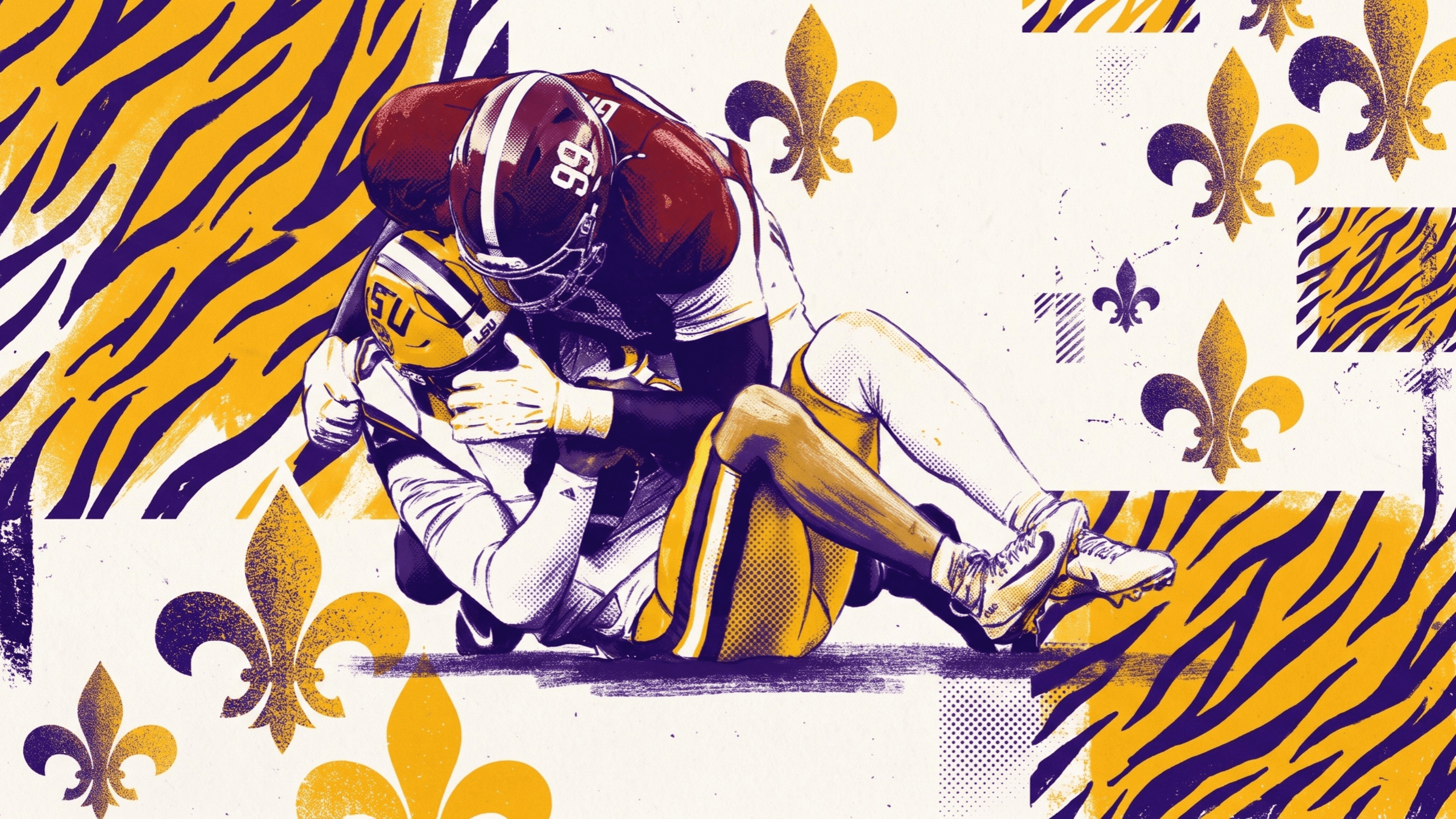
If you were told that LSU had 172 more yards than Alabama and 14 more first downs, you would surely believe the Tigers got the win. Instead, LSU went on to lose at home 31–13 in disappointing fashion.
Even though it is a long shot, the now 24th-ranked LSU Tigers are still able to make the College Football Playoff, but they need to win out and get help from some other teams. Their remaining three games aren’t going to be easy (Texas, Tennessee, and Arkansas), but they are still in the hunt.
Let’s look at what went wrong against Alabama and how they can correct it moving forward.
Drive #1
Alabama got the ball first and ended their opening drive with a field goal to go up 3–0. LSU’s first response was a solid, 13-play, 70-yard drive that also ended in a field goal to tie it 3–3.
The Tigers reached 1st & goal at the Alabama 8-yard line, where offensive coordinator Charlie Weis Jr. dialed up a Split Zone RPO Quick Screen concept. Quarterback Sam Leavitt handed it off to running back Dilin Jones for a 1-yard gain.
Disguised Blitz
Facing 2nd & goal from the 7-yard line, Weis Jr. dialed up a QB Draw RPO concept. Leavitt looked to the boundary for a slot fade. If the safety overhead stayed in the box, Leavitt would throw the slot fade; if the safety played the slot fade, Leavitt would run it. Alabama blitzed the pressed safety, Bray Hubbard, from the boundary, who went unaccounted for in the draw concept. This, paired with an interior slant by the 3-technique, forced Leavitt to bounce the draw further outside, making it difficult for the center to get a good block working up to the linebacker. Leavitt managed to pick up 2 yards.
Hot with Shock
Now facing 3rd & goal from the 5-yard line, Weis went to a trips formation and dialed up a Shock concept. Alabama lined up in a variation of Cover 0, walking down seven defenders to show pressure. With the running back in, LSU had six blockers for seven defenders. LSU went with zero protection (five blockers for the interior five rushers), meaning the running back was responsible for picking up the rusher on the opposite side of the trips formation.
This made Leavitt "hot" off the unblocked edge rusher toward the trips side, with the slot fade as his hot route. The edge rusher came clean, making Leavitt hot; Leavitt pumped the throw, made the defender miss, and scrambled for an incompletion. LSU kicked a field goal on the next play, tying the game 3–3.
While LSU had a solid protection and hot plan here, the Shock concept near the goal line is not an ideal concept. There is simply not enough grass to win on the slot fade route, and the cornerback can easily come off a hitch route to intercept the throw.
This is a members-only post. Continue reading the full breakdown on Substack.
Read on Substack →