
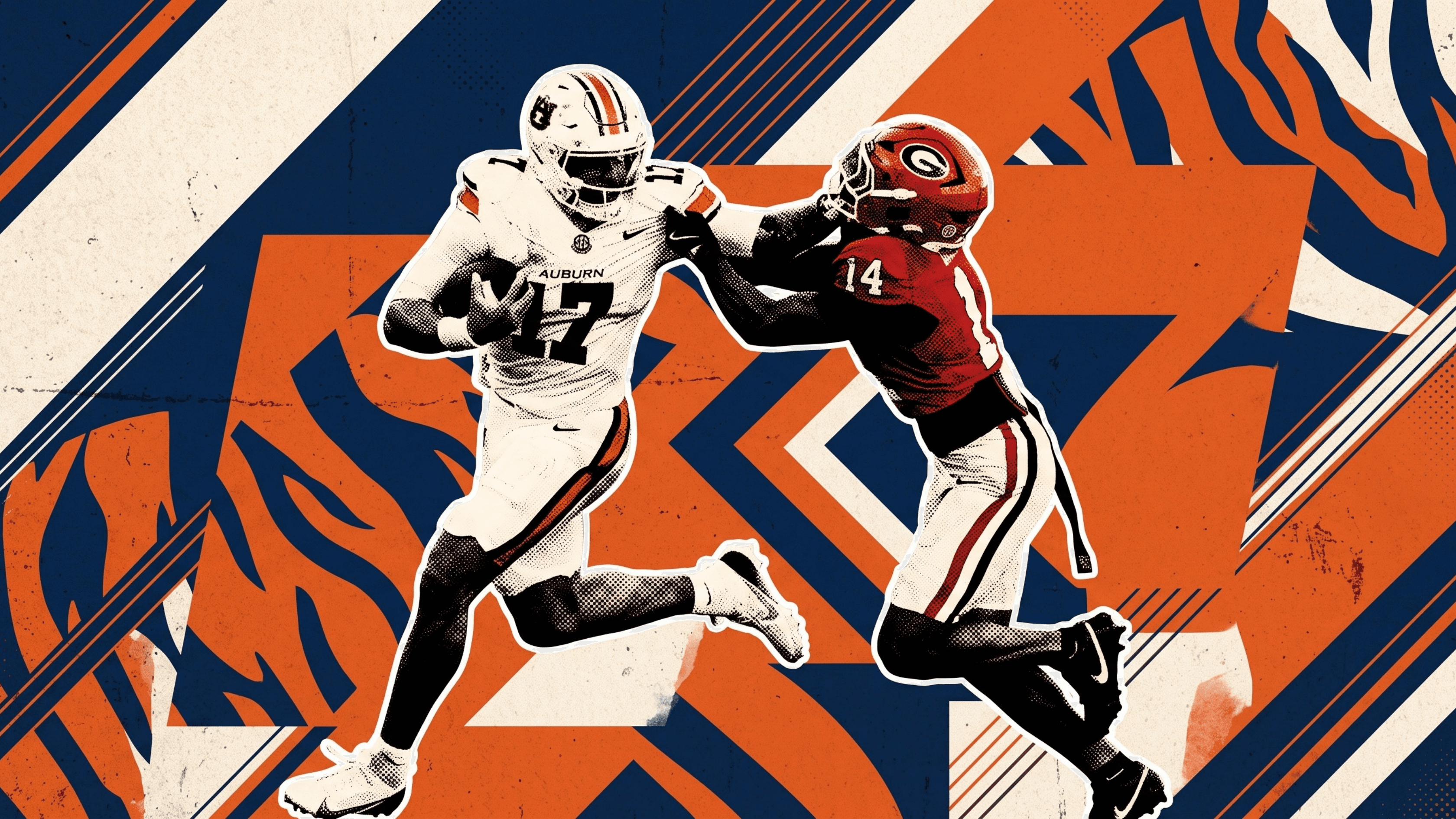
Auburn didn’t take down Georgia’s defense with an abundance of explosive plays; they did it by bleeding them three, four, and five yards at a time. Finishing with 4.2 yards per carry to UGA’s 4.0, the Tigers dismantled the front methodically by dialing up the quarterback run game, attacking the perimeter, and cycling through a deep catalog of run schemes.
Below, we break down the schematic “thousand cuts” Auburn used to stay on schedule and control the game on the ground.
Power Read Toss
It was evident early that offensive coordinator Joel Gordon wanted to lean on Power Read Toss in both the run and pass game. Power Read Toss stresses a front like Georgia’s for three key reasons: it allows the offensive line to leave an edge defender unblocked to read him, gets the ball carrier out to the perimeter in a hurry, and sets up the play-action.
Gordon dialed up Power Read Toss three times, averaging 4.3 yards per carry. On the seventh play of the game, Auburn crack blocked on the perimeter and led with a wing for the toss, picking up seven yards right out of the gate while immediately laying the groundwork for complementary play-action looks off the same action.
Later in the contest, Gordon returned to the exact same formation and motion. Instead of tossing it or keeping on Power Read, Auburn flashed the toss, and ran a Drive concept with a lead swing as the checkdown. Auburn dialed up this paired look three times, averaging 9.0 yards per play.
Auburn also leaned on a Power Read Shovel RPO variant on 4th & 3. Quarterback Byrum Brown rolled to the trips side, reading the defensive end to decide between delivering the snag concept or shoveling the ball back inside to the running back following the pulling guard. When the defensive end widened with the sprint-out action, Brown flipped the shovel inside to pick up three yards and keep the drive alive.
Outside Zone
Outside Zone served as Auburn's base staple, called 12 times across various tags and averaging 4.6 yards per carry. Much like Power Read, Outside Zone stretches the defense horizontally while creating a numbers conflict through read options or RPO tags.
While head coach Alex Golesh stems from the Veer & Shoot tree, famous for ultra-wide receiver splits, he and Gordon use the look selectively. Here, they dialed up an Outside Zone RPO tagged with backside slants from wide splits. Even with the slot slant open, Auburn cleanly secured five-on-five in the box, allowing the running back to rip off a 14-yard gain without needing to account for the unblocked backside linebacker.
To open the second half, Auburn orchestrated a 9-play, 76-yard touchdown drive to take a 24-14 lead. The capping score came on an Outside Zone Read tagged with a backside wing wrap. Brown read the backside defensive end crashing hard, pulled the ball, and followed his wrapping wing into the end zone.
GT Counter Bash
Auburn called GT Counter Bash just once, but it landed as another precise blow against Georgia’s front. In contrast to traditional counter, Bash flips the responsibilities: Brown reads the defensive end to pull the ball on the interior GT action or hand off to the perimeter sweep.
Backed into a 1st & 20 following a holding penalty, Gordon bypassed an obvious dropback passing situation and attacked a light box on the ground. Brown’s long frame and patience at the mesh point allowed him to ride the exchange, force the defensive end to commit, and pull the ball himself for an easy 10-yard pickup to put Auburn back ahead of the chains.
QB Pin & Pull
Perhaps Auburn’s most effective run design of the afternoon, QB Pin & Pull was called three times for an average of 8.7 yards per attempt. Unlike Power Read, Outside Zone, or GT Counter Bash, this is a locked run without a read element.
Facing a 3rd & 1, Auburn aligned in a tight trips formation, a look where defenses routinely anticipate Duo or heavy downhill gap schemes. With Georgia braced for an interior push, Brown kept the ball on the perimeter behind two down/pin blocks and three pullers, ripping off a 20-yard gain.
QB GR Counter
Another locked quarterback run Auburn utilized was QB GR (Guard-Running Back) Counter, dialed up twice for an average of 11.5 yards per carry, including an 18-yard explosive from Brown.
Against Georgia’s Tite front, there was no defensive end for the backside pulling guard to kick out. In this ruleset, the guard wraps for the frontside linebacker or kicks the apex defender fitting into the box, while the running back leads through to fit off the guard's block. The guard wrapped cleanly to the frontside backer, but the back missed the apex defender. Brown compensated with his legs, slipping the unblocked defender in space to generate an 18-yard cut.
QB Split Zone
The final scheme to highlight is QB Split Zone. Gordon called this look only once, but it proved decisive on a critical 3rd & 2 that set up Auburn’s second touchdown.
Auburn aligned in empty with an offset wing and tagged an RPO screen to the perimeter. With six blockers matched cleanly against Georgia’s six-man box, Brown kept the ball on the split-zone action, following the wing's block across the formation to convert the first down with ease.
Back-to-Back Upsets
Auburn ran 11 different run concepts in their win over Georgia, leaning on Byrum Brown to shoulder the load with 115 yards and a touchdown on 26 carries.
Now sitting at 4-2, Auburn heads into a pivotal matchup against LSU on Saturday, October 24. If the Tigers hope to pull off back-to-back ranked upsets, they will once again need to run the quarterback, attack the perimeter, deploy a variety of run concepts, and set up play-actions. That’s how they deliver another death by a thousand cuts.